
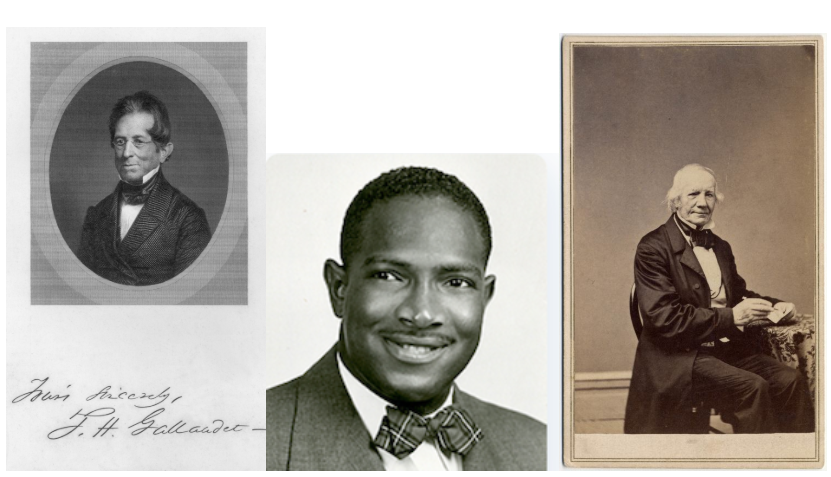
National Deaf History Month (April 1-30) is a time to celebrate the educators, advocates, and leaders who transformed Deaf education in the United States and beyond. It’s more than a historical reflection. It’s a reminder that access to language, education, and opportunity has always required courage, advocacy, and community.
By highlighting Deaf history in education, we recognize how far we’ve come and the responsibility we share in continuing that progress.
Trailblazing Educators


Early advocates fought tirelessly to establish formal education for Deaf students at a time when access was extremely limited.
-
Thomas Hopkins Gallaudet partnered with Laurent Clerc to co-found the first permanent school for Deaf students in the United States in 1817. Their collaboration laid the foundation for bilingual Deaf education.
-
Andrew Foster expanded Deaf education across Africa, founding dozens of schools and empowering thousands of Deaf students.
-
I. King Jordan, the first Deaf president of Gallaudet University, became a global symbol of Deaf leadership and educational equity following the historic Deaf President Now movement.
These leaders not only built institutions. They shifted perceptions about Deaf capability, intelligence, and leadership.
Innovations in Learning

Deaf educators have long championed language access as the foundation of academic success. Their innovations include:
-
Incorporating sign language into classroom instruction
-
Developing bilingual-bicultural (Bi-Bi) education models
-
Creating visual learning tools and accessible teaching materials
-
Advocating for interpreters and captioning in mainstream settings
Research consistently shows that when Deaf students have full access to language early on whether through American Sign Language (ASL), spoken language supports, or both – they thrive academically and socially.
These advancements continue to influence how schools approach inclusive education today.
Mentorship and Community
Beyond curriculum, Deaf pioneers emphasized mentorship and representation. Seeing Deaf teachers, administrators, and leaders in academic spaces reinforces the message that Deaf students belong in higher education, professional fields, and leadership roles.
Programs that foster peer mentorship, Deaf role models, and community involvement strengthen confidence and identity. Many of today’s Deaf professionals credit earlier generations for paving the way proving that representation truly matters.