

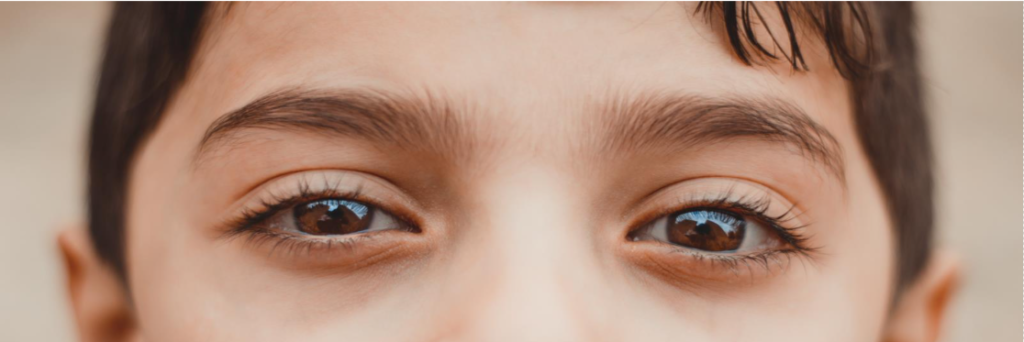
 Limited or no eye contact in children may be an early sign of developmental differences. Learn what it means and how parents and professionals can support positive outcomes.
Indicator #2: Use of Eye Contact
Understanding Little or Limited Eye Contact in Children
Eye contact is one of the earliest and most significant forms of social communication. From infancy, children typically begin to connect with others through eye gaze, laying the foundation for language development, emotional bonding, and social learning. However, when a child demonstrates limited or no eye contact, it may raise concerns for parents and caregivers.
Why Eye Contact Matters
Eye contact plays a crucial role in early social development. According to research by Senju and Johnson (2009), infants as young as two to five days old show a preference for looking at faces and making eye contact. This instinctual behavior supports social interaction, joint attention, and later, the ability to understand others’ emotions and intentions.
When this behavior is absent or reduced, it can affect a child’s ability to engage socially and emotionally with others. Persistent difficulties with eye contact can be an early indicator of developmental differences, including, but not limited to, autism spectrum disorder (ASD), sensory processing disorders, or communication delays.
Limited Eye Contact and Autism
One of the most common associations with limited eye contact is autism. Children on the autism spectrum may avoid or struggle to maintain eye contact due to difficulties in social processing or sensory sensitivities. Research has shown that children with ASD often process faces differently than their neurotypical peers. A study by Klin et al. (2002) found that toddlers with autism spent significantly less time looking at the eyes and faces of people in videos compared to typically developing children.
While this behavior alone does not confirm a diagnosis, it can be a red flag when observed alongside other signs such as delayed speech, lack of social interest, or repetitive behaviors.
Other Potential Causes
It’s important to recognize that limited eye contact isn’t exclusive to autism. Some children may struggle with eye contact due to:
- Shyness or social anxiety – Children who are very shy may avoid eye contact in unfamiliar or stressful situations.
- Cultural factors – In some cultures, direct eye contact with adults is considered disrespectful, which can affect a child’s learned behavior.
- Sensory sensitivities – Children with sensory processing challenges may find eye contact overwhelming or uncomfortable.
When to Be Concerned
Occasional lack of eye contact isn’t typically a cause for concern, especially in babies or toddlers still developing their social awareness. However, you may want to consult a pediatrician or specialist if your child:
- Rarely or never makes eye contact by 6 months
- Doesn’t follow your gaze or gestures
- Seems uninterested in social games like peek-a-boo
- Shows other signs of developmental delay
The American Academy of Pediatrics recommends developmental screenings at 9, 18, and 30 months, with specific autism screenings at 18 and 24 months (Hyman, Levy, & Myers, 2020).
What Parents and Professionals Can Do
If you’re concerned about your child’s eye contact, early intervention can make a significant difference. Speech-language pathologists, developmental pediatricians, and occupational therapists can help assess the underlying cause and support your child’s communication skills.
Therapies such as Applied Behavior Analysis (ABA) or Early Start Denver Model (ESDM) have been shown to improve social engagement and communication in young children with autism (Dawson et al., 2010).
Final Thoughts
Limited or no eye contact is a behavior worth watching, but it should always be considered in the broader context of a child’s development. Trust your instincts as a parent or caregiver and seek guidance if something feels off. Early support leads to better outcomes, whatever the underlying cause.
Every child grows and develops in their own unique way. While limited or no eye contact can sometimes signal an underlying concern, it is only one piece of a much bigger picture. If you have questions about your child’s development, trust your instincts and seek guidance from qualified professionals.
Early support can make a meaningful difference not just for communication skills, but for your child’s confidence, relationships, and overall well-being. At MT & Associates, we believe that every child deserves access to understanding, inclusion, and the opportunity to thrive.
If you’d like to learn more about supporting communication development or finding the right resources, we’re here to help. Together, we can build stronger, more inclusive communities one connection at a time.
References:
- Dawson, G., Rogers, S., Munson, J., Smith, M., Winter, J., Greenson, J., … & Varley, J. (2010). Randomized, controlled trial of an intervention for toddlers with autism: the Early Start Denver Model. Pediatrics, 125(1), e17-e23.
- Hyman, S. L., Levy, S. E., & Myers, S. M. (2020). Identification, Evaluation, and Management of Children With Autism Spectrum Disorder. Pediatrics, 145(1), e20193447.
- Klin, A., Jones, W., Schultz, R., Volkmar, F., & Cohen, D. (2002). Visual fixation patterns during viewing of naturalistic social situations as predictors of social competence in individuals with autism. Archives of General Psychiatry, 59(9), 809–816.
- Senju, A., & Johnson, M. H. (2009). The eye contact effect: mechanisms and development. Trends in Cognitive Sciences, 13(3), 127-134.
*** Information contained in this blog is for educational purposes only and does not suggest a formal diagnosis in any way. If a developmental concern is present, it is suggested that the caregiver seek professional support and guidance.