By the Handled. ASL Interpreting Team | Last updated: November 2026
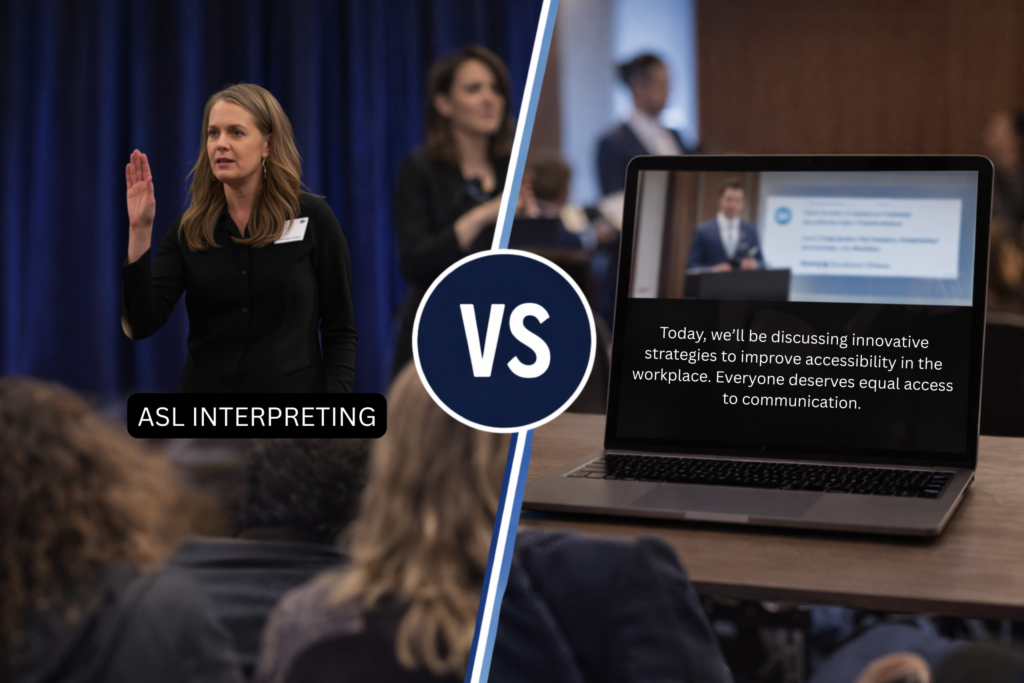
ASL interpreting and CART captioning both provide communication access, but they often serve different people. ASL interpreting is for people whose primary language is American Sign Language. CART captioning is for people who prefer reading English, including many Hard of Hearing people. The best way to choose is simple: ask the people who will use the service. Some events need both.
What is ASL interpreting?
An ASL interpreter conveys spoken English into ASL, and ASL into spoken English, in real time. ASL is a complete language with its own grammar, so interpreting carries meaning, tone and cultural nuance, not just words. It works especially well for back-and-forth conversation, like meetings, trainings, Q&A and networking.
What is CART captioning?
CART (Communication Access Realtime Translation) is live, word-for-word text written by a trained human captioner as people speak. Captions appear on a screen, within your meeting platform, or through a link on a personal device. Ask about a transcript afterward, too. It’s helpful for notes and review.
How do I choose?
| ASL Interpreting | CART Captioning | |
|---|---|---|
| Best for | People whose primary language is ASL | People who prefer reading English |
| Works especially well for | Discussion, Q&A, networking | Presentations, lectures, multiple speakers |
| Added benefit | Carries tone and cultural meaning | Transcript available afterward on request |
When do you need both?
When your audience includes both ASL users and people who prefer reading, offer both, so every attendee gets access that works for them. This is common at conferences and larger events. Captions also help everyone: anyone in a noisy room, listening to an unfamiliar accent, or who simply processes better by reading.
What about AI or automatic captions?
AI captions have impr oved, and they can be a useful tool. But they aren’t always accurate, and accuracy is the whole point of access.
- Live meetings and events: AI-only captions often miss names, technical terms, accents and crosstalk, don’t identify who’s speaking, and can produce errors that are confusing or even offensive. For live events, a human captioner is the reliable choice.
- Recorded video: AI works well as a first draft. Ours is then reviewed by a trained human for accuracy, spelling and names before it’s delivered.
- Captions don’t replace ASL. Captions are written English, and ASL is a different language. For ASL users, an interpreter provides the access they need.
- Your AV team isn’t your access provider. Many events ask their audio-visual company to add captions because it seems like a tech add-on, but AV companies usually rely on AI-generated captions. Interpreting and captioning are language services, so book them with a specialist and let your AV team support them with screens, sound and a clean audio feed.
Why asking first matters
The person using the service knows what works best for them. Some rely on ASL, while others prefer captions for easier reading and note-taking. Accessibility works best when it starts with asking, not assuming.
Frequently Asked Questions (FAQS)
Can we have ASL interpreting and CART captioning at the same event?
Yes. Many events offer both, so every attendee can choose what works best for them. We can coordinate both through one booking.
Are the automatic captions in Zoom or Teams good enough?
They can help as a backup, but they often miss names, technical terms and speaker changes. For meetings and events where everyone needs to follow along, a human captioner is the reliable choice.
Do ASL interpreting and CART work for virtual meetings?
Yes. Both work remotely for virtual meetings, webinars and hybrid events, as well as on site.
Not sure which your event needs? Tell us about your audience, and we’ll recommend the right fit and handle the rest. [Request Services] or call 314-896-0ASL (0275).
About Handled. ASL Interpreting: Handled. ASL Interpreting, a DBA of MT & Associates, LLC, provides ASL interpreting, live captioning and video accessibility services from St. Louis to clients nationwide. Founded by Shelly Tisius, RID-NIC, MICS5/BEI-Master.