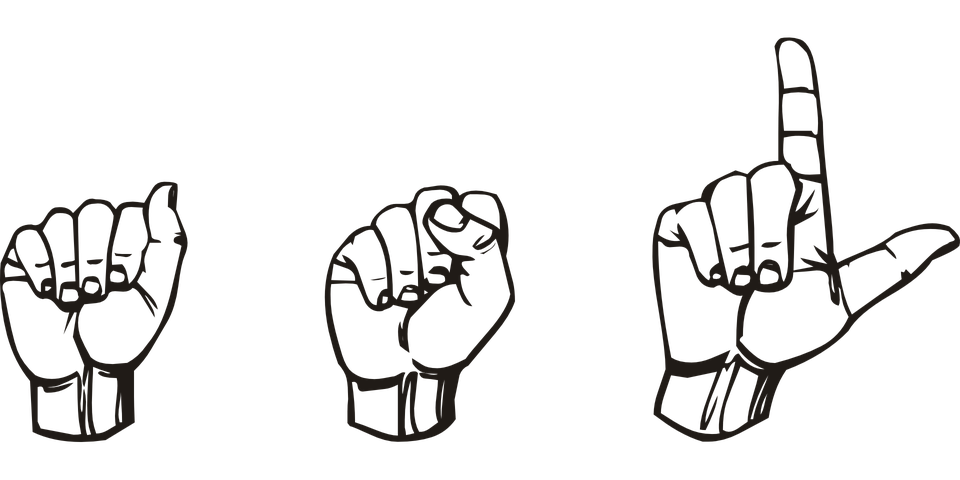
Illustration of hands signing three ASL letters

What does a sign language interpreter mean when they ask you, “What is your Deaf customer’s language mode?”  There are various language modes the Deaf and hard of hearing community may use.

A person who is Deaf or Hard of Hearing has their own preferred sign language mode. Some use ASL while others prefer a more English grammar signed language. Some may also use Signed Exact English (SEE) or depend on reading lips.
various language modesAmerican Sign Language (ASL)

ASL has its own grammar and vocabulary with cultural and regional variations.  Quality Sign Language Interpreters are professionals in knowing how to determine appropriate cultural mediation when provide an interpretation.  Each spoken language around the world cannot simply be translated word for word.  There may be idioms, grammar differences, and other cultural influences on language based on region and experience.  It is the same with signed languages.

The culture plays a big role in idiomatic phrases and a real world translation from one language to another whether spoken or signed.  See examples below of literal versus conceptual translations from spoken French to English. (https://frenchtogether.com/french-idioms/)  English has many idioms that, if literally translated into ASL, would not make any sense.  For example, “They are like two peas in a pod.”  This of course refers to two people being inseparable.  A commonly used ASL idiom literally translates into English, “Train gone.”  But this conceptually means “the opportunity has passed you by.”

Pidgin Signed English (PSE)

PSE is the commonly used term for a contact language between ASL and spoken English.  Instead of using ASL grammar, it incorporates English grammar while using conceptually accurate signs.  Many Deaf and hard of hearing people prefer interpreters to use this this language mode so they know the exact English spoken.  This way they can respond using the precise English terminology used by the speaker.  At other times, they may have a background in English making it easier to receive visual language in an English sentence format.  There may be various reasons for the use of a contact sign language.

Signed Exact English

SEE is a form of English on the hands.  It is less conceptually accurate then PSE and focuses on communicating English words in a visual way to those who cannot hear a spoken language.  It is not as commonly used as ASL or PSE.

Oral/Lip-Reading

An interpreter may still be requested even for a customer who prefers to read lips.  Often times a speaker is not clear to see or multiple speakers are in an environment.  This commonly occurs in a classroom or presentation where there are large groups of people.  A sign language interpreter may be required to make language visibility clear and stationary even if the customer is lip-reading.  Qualified interpreters know how to properly move their lips to be clearly understood.  They also may add information such as where the speaker is sitting/standing and what they look like so the customer does not have to look around the room thus breaking their concentration on the language.

Conclusion

This is not a comprehensive list of various language modes your Deaf customer may request.  Be sure to ask them what they prefer before making any assumptions.  And recognize many may code switch using multiple language modes depending on the setting they are in.


Additional Resources:

Famous Idioms | Meaning

Communication Options for a Child who is Deaf or Hard of Hearing


Photo Credit:

https://pixabay.com/en/sign-language-american-language-40466/
shelly-headshot-3-brand.webp

Shelly Tisius (she/her), RID-NIC, MICS5/BEI-Master

Founder, CEO, and ASL Interpreter

I've been leading teams since long before I became a professional interpreter in 2002, and I worked my own way through school, so I know what it means to build something from the ground up. In 2013 I founded MT & Associates, now Handled. ASL Interpreting, and today I lead how we work, so every detail is handled for our clients.

Categories

Tablet showing an online Create Your Calm workshop

The Communication Access Planning Guide

A free starter guide to planning interpreting and captioning for your event, campus, agency, or workplace. Learn how much notice to give, what each service does, and how to book with confidence. Every guide includes a section for your audience, so you get what’s relevant to you.

Blue circular icon of an I love you handshape

Communication access shouldn't be one more thing to figure out.

See how our ASL interpreting, live captioning, and audio description services can support your event, campus, agency, or workplace. Consider it handled.

Shelly Tisius, Founder and CEO

Shelly Tisius (she/her),
RID-NIC, MICS5/BEI-Master

Founder, CEO, and ASL Interpreter

I’ve been leading teams since long before I became a professional interpreter in 2002, and I worked my own way through school, so I know what it means to build something from the ground up. I’ve done every part of this work, and I love it all. In 2013 I founded MT & Associates, now Handled. ASL Interpreting, and today I lead how we work, so every detail is handled for our clients.

Outside of work, I’m a proud military spouse and mom, usually on the go with my kids.

Bryce Buckley, Operations Manager

Bryce Buckley (he/him)

Operations Manager

As a first-generation college student supporting myself through school, I developed a passion for helping others access the resources and support they need. After several years advocating for students and their families in higher education, I now bring that same commitment to my role as Operations Manager at Handled. ASL Interpreting. I am honored to support our mission of serving the Deaf community and helping people feel heard, understood, and connected.

Bryce spends much of his free time crocheting, bowling, at the gym, with friends, and spending time with his partner and chihuahua, Mabel.

Rain Pioquinto, HR and Social Media Specialist

Rain Pioquinto

HR & Social Media Specialist

Rain Pioquinto helps keep day-to-day operations organized, assists with team and office needs, and supports Handled. ASL Interpreting marketing and communications. She enjoys working behind the scenes, keeping things running smoothly, and finding ways to make everyday processes easier for the team.

Outside of work, she loves spending time at home with her family, occasionally tending to her garden, and enjoying a good cup of coffee.

Caleb Miller, Operations Coordinator

Caleb Miller, BEI Basic

Operations Coordinator

Caleb Miller brings over a decade of experience working alongside the Deaf community to his role as Coordinator. As a certified interpreter (BEI - Basic), he loves applying the skills and insights he has gathered over the past 10+ years to ensure smooth, successful language access for everyone.

Outside of the office, Caleb loves spending quality time with his wife, Natalie, and their two dogs, Marnie and Winnie. When he isn't out on the disc golf course, you can usually find him tackling a good home project in his spare time.

Shannon Veneziani, Operations Coordinator

Shannon Veneziani

Operations Coordinator

Shannon Veneziani helps clients and interpreters know what to expect before every assignment. Whether she's confirming where to meet for a class or finding coverage when a schedule changes, she makes sure everyone has the details they need. Before joining the team, Shannon spent a decade in the coffee industry, managing shops and training new managers across several states. That experience sparked a passion for operations and taught her that the best plans leave room for change, and the questions that are easy to overlook are often the most important ones.

Outside of work, Shannon is usually at the gym, with her family or at home with her cavapoo, Willie. And yes, she can still make you a great cup of coffee.

Scroll to Top